


Set Default Page Add to Favorites Send This Page to FriendReadyPlanet.com
dot dot
dot
dot
dot
dot
dot
dot


Phuket Insulation
visa run to ranong 1,500.- fully inc.
25,000.- we show money for you. fully inc.
4,000B./ VISA PENANG Tel. 0818 929 960
15,000.- for 1 year visa business Tel. 0818 929 960


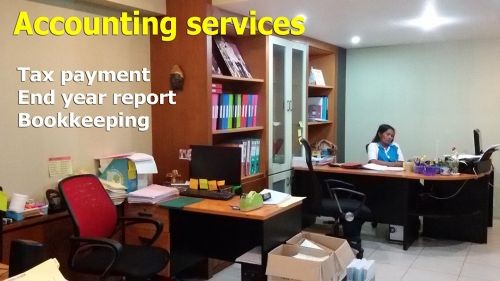
Accounting & Auditor


PLEASE COME TO PAY FOR กรุณาเข้ามาชำระค่าบริการ

-MONTHLY BOOKKEEPING SERVICE
-ค่าบริการทำบัญชีรายเดือน

-SALARY TAX.
-ภาษี เงินเดือน

-SOCIAL SECURITY
-ประกันสังคม

-HOLDING TAX.
-ภาษีหัก ณ ที่จ่าย

BEFORE THE 5th. OF THE MONTH
ก่อนวันที่ 5 ของทุกเดือน

*IF COME LATER YOU WILL BE LIABLE TO PAY FINE 1.5% OF PAYMENT + 200 EXTRA SERVICE.
*หากท่านไม่มาชำระตามกำหนดจะต้องเสียค่าปรับ 1.5% และค่าบริการอีก 200 บาท


Accounting Service or Book Keeping Service 1,500 Baht per month
บริการรับทำบัญชี หรือ ลงบัญชี เพียงเดือนละ 1,500 บาท 


Please inform to us if you can not bring income and expenses bill to our office we have messenger to receive at your office no more charge

โปรดแจ้งให้เราทราบ หากคุณไม่สามารถนำเอกสารเกี่ยวกับรายได้และค่าใช้จ่ายมาให้เรา เรามีพนักงานรับส่งเอกสาร เพื่อไปรับเอกสารที่สำนักงานของคุณ โดยไม่มีค่าใช้จ่ายเพิ่มเติม


Duties of Partnership Company


          Limited Partnership or Registered Ordinary Partnership registered under Civil and Commercial Code must close account within 12 months from the date of the registration and file with the Business Development Office, Ministry of Commerce or Provincial Office within 5 months of the end of fiscal year even if the firm hasn’t been operated or temporary closed. Otherwise a penalty of maximum 50,000 Baht shall be applied.


            Company Limited


1)      A Company Limited should close account every 12 months. The performance record is to be certified by the company auditor, presented and approved by shareholders within 4 months after the account closure and submit to Business Development Office, Ministry of Commerce or Provincial Office within 1 mouth after the account approval  even if the firm hasn’t been operated or temporary closed. Otherwise a penalty of maximum 50,000 Baht shall be applied.


2)      A Company Limited should prepare a copy of current shareholder list and former shareholders who have ended their status after the last general meeting and submit to Business Development Office, Ministry of Commerce or Provincial Office within 14 days after the meeting date otherwise a penalty of maximum 10,000 Baht shall be applied.


3)      A Company Limited should organize a general meeting within 6 months after the registration date and should organize at least 1 meeting every 12 months otherwise a penalty of maximum 20,000 Baht shall be applied.


4)      A Company Limited should prepare and distribute stock bonds to shareholders otherwise a penalty of maximum 20,000 Baht shall be applied.


5)      A Company Limited should keep book of company’s shareholder otherwise a penalty of maximum 20,000 Baht shall be applied.


In case a corporate registered fails to submit the annual account as stated by law, not only the corporate registered is guilty but also the managing partner, managing director or board of director who has the authority to act for the corporate registered are to received the same penalty as the corporate registered. 


Your 1 stop office for all your accounting and business services

Important notice For Company Limited (Co., Ltd.) or Limited Partnership (Ltd., Part.)In Thailand you have to make report to government office. Every month, every 6 months, and every 12 months. (At the end of each year must submit yearly report for the tax office) present to revenue office and business development office. For Co., Ltd. and Ltd., Part. After registration or set up of your business you have to employ licensed accounting company to do your accounts. We are licensed to do all your accounting No. 83200263, office member No. 53 from Phuket revenue office. Bookkeeping with CD Organizer program certificate by revenue office. Persons who have income in Thailand but do not have a company must also send monthly 6 monthly and yearly accounts. We hope the information we give you helps you understand your tax and social payments, and we will be pleased to take care of all your accounting needs.    


AUDITOR ACT, B.E. 2505 (1962)
------------------------------
BHUMIBOL ADULYADEJ, REX.
Given this 30 th day of October, B.E. 2505 (1962)
Being the 17 th year of the present reign

His Majesty King Bhumibol Adulyadej has been graciously pleased to proclaim that:
Where as it is expedient to enact a law relating to auditor,


Be it, therefore, enacted by the King, by and with the advice and consent of the Constituent Assembly in its capacity as the Parliament, as follows:

Section 1. This Act shall be called the "Auditor Act, B.E. 2505 (1962)".

Section 2. This Act shall come into force on and from the day following the
date of its publication in the Government Gazette.

Section 3. In this Act:
"Authorized Auditor" means person who has been granted licence to act as an auditor under this Act, and which licence has not yet expired or has not been suspended or revoked.
"Minister" means the Minister having charge and control of the execution of this Act.

Section 4. There shall be a board called the "Board of Supervision of Auditing Practices" abbreviated as "B.S.A.P." , consisting of the Under - Secretary of State for Economic Affairs as chairman, the Director-General of the Commercial Registration Department, the Director-General of the Comptroller-General Department, the Director-General of the Revenue Department, the President of the Audit Council of Thailand, the Dean of the Faculty of Commerce and Accountancy of the Chulalongkorn University and the Dean of the Faculty of Commerce and Accountancy of the Thammasat University as ex officio members, and eight other members appointed by the Minister, of which not less than half shall be nominated from authorized auditors.

The B.S.A.P. shall select one of its members as vice-chairman who shall have the duty of assisting the chairman in all affairs within his powers and duties, as assigned by him, and who shall act for the chairman when he is absent or when he is unable to discharge his duties.

The members appointed by the Minister shall hold office for a term of two years each time, and may be re-appointed but not for more than two consecutive terms.

Section 5. The member appointed by the minister vacates office upon:

(1) completion of office term;
(2) resignation;
(3) suspension, revocation or expiration of his authorized auditor licence;
(4) becoming bankrupt;
(5) becoming incompetent or quasi-incompetent;
(6) being sentenced to imprisonment by final court's judgement, except where it is punishment for a petty offence or for an offence committed through negligence.

Subject to Section 4, when a member appointed by the Minister vacates office prior to rotation, the Minister may appoint other person as replacement member.

The replacement member shall be in office for the remainder of term of office of his predecessor.

Section 6. When the members appointed by the Minister vacate office at end of office term, they shall remain in office until the newly appointed members will have assumed duties.

Section 7. The office of the B.S.A.P. shall be set up in the Ministry of Economic affairs, with a registrar responsible for the maintaining of the register of authorized auditors and for other general affairs, and shall be manned with a reasonable number of staff. The registrar shall concurrently act as the secretary of the B.S.A.P.

Section 8. The chairman shall be the person to summon meetings of B.S.A.P. from time to time as deemed appropriate.

Members of a number of not less than five may subscribe their names to request the chairman to summon a meeting of B.S.A.P.

Section 9. A meeting of the B.S.A.P. shall require a quorum of not less than one half of the total number of members. If the chairman and the vice-chairman are not present at any meeting or are not able to perform their duties, the members present shall select one among themselves as the chairman of that meeting.

Subject to Section 10, decision of a meeting of B.S.A.P. shall be by a majority of votes. Each member shall have one vote. In case of a tie, the chairman of the meeting shall have an additional vote as a casting vote.

Section 10. The following resolutions of B.S.A.P. meeting shall require not less than two-thirds of the total votes:

(1) Resolution to suspend or revoke an authorized auditor licence;
(2) Resolution to re-register an auditor whose licence has previously been revoked as authorized auditor as stated in Section 20.

Section 11. The B.S.A.P. has the following powers and duties:

(1) To register and issue licence to authorized auditors;
(2) To suspend or revoke licence of an authorized auditor;
(3) To issue regulations laying down the principles and procedures for the application for and the issuance and the renewal of authorized auditor licence, as well as for the issuance of substitute thereof;
(4) To give counsels and advices to universities or other educational institutes regarding auditing practice

Section 12. The B.S.A.P. has the power to appoint sub-committees to attend to any business or to investigate into any matter within the scope of its powers and duties. The provisions of Section 9 shall apply to the meetings of sub-committee mutatis mutandis.

Section 13. Where auditing is required by law or where the law provides for auditors, no person may sign in certification of an auditing in the capacity of an auditor, except;

(1) authorized auditor, or
(2) where it is an official duty.

Section 14. Any documents required by law to be certified by an auditor must bear signature, in certification, of an authorized auditor or else they shall not be valid under the provisions of such law.

The provisions of paragraph one shall not apply to official documents.

Section 15. To be eligible for registration as an authorized auditor, person must:

(1) have degree in accountancy or hold certificate in accountancy recognized by the B.S.A.P. as not lower than the bachelor degree in accountancy, or have a degree or a certificate not lower than bachelor degree toward which the course includes accountancy studying and which is considered by the B.S.A.P. as fit for being an authorized auditor;
(2) have experience in auditing and considered by the B.S.A.P. as fit to become an authorized auditor;
(3) have completed his twentieth year of age;
(4) be a citizen of Thailand or of a country which permits Thai citizen to become auditor in that country;
(5) not be a person of bad conduct or who lacks in morality;
(6) have never been sentenced to imprisonment in a case considered by the B.S.A.P. as may bring discredit to the profession;
(7) not be an insane or mentally unsound person;
(8) not engage in any other occupations which are not suitable or which will deprive him of the freedom to perform the duties of auditor.

Section 16. An authorized auditor licence shall be valid for five years from the date of its issuance.

Section 17. An authorized auditor must have an office and inform the B.S.A.P. of which at the time of submitting application for licence.

In the case of there being no office, an authorized auditor may use his dwelling place as his office.

In the case of office removal, the authorized auditor concerned must report it to the registrar within fifteen days from the date of removal.

Section 18. An authorized auditor must observe etiquette as prescribed in Ministerial Regulations.

Section 19. A suspension or a revocation of licence, as mentioned in Section 11(2) may be ordered for when an authorized auditor is found:

(1) lack of any of the qualifications required under Section 15, or
(2) having violated this Act or Ministerial Regulations issued under this Act

A suspension of licence shall not exceed one year each time.

Before any suspension or revocation of licence is made, inquisition shall first be made in order to give the authorized auditor concerned a chance to be aware of the charge and to make statement in defence.

In carrying out an inquisition, the B.S.A.P. or the sub-committee appointed by the B.S.A.P. shall have the power to summon, in writing, any person to give statements or to send documents or any materials for consideration.

Section 20. A person whose authorized auditor licence has been revoked may apply for registration as an authorized auditor again after the lapse of three years from the date his licence is revoked. However, if the B.S.A.P., after due consideration, refuses to issue him the licence, he my submit an application again only after the lapse of a period of one year from the date of such refusal by the B.S.A.P. If the B.S.A.P. refuses to issue the licence for the second time, the said person shall no longer have the right to apply such registration again.

Section 21. Whoever violates Section 13 shall be punished by imprisonment for not more than one year or by a fine of not more than Baht ten thousand, or by both such imprisonment and fine.

Section 22. Whoever, not being an authorized auditor, makes known to the public by any means, that he is an authorized auditor shall be punished by imprisonment for not more than six months or by a fine of not more than Baht five thousand, or both such imprisonment and fine.

Section 23. In the initial stage, the B.S.A.P. shall consist of the Under-Secretary of State for Economic Affairs as chairman, ex officio members as mentioned in Section 4 and eight other members as appointed by the Minister.

When the number of authorized auditors reaches fifty, the members appointed by the Minister shall vacate office and the Minister shall appoint members anew as provided in Section 4, paragraph one.

Section 24. The provisions of Section 13 and Section 14 shall not be applicable until one hundred and eighty days from the date this Act comes into operation have lapsed.

Section 25. Within the period of one hundred and eighty days from the date this Act comes into force, those who have practised auditing and signed in certification of auditing of accounts of juristic persons in Thailand in the capacity of auditors for a period of not less than five successive years, by attaching signiture in certification of their auditing for not less than five juristic persons per year, and who possess the qualifications required under Section 15(3), (4), (5), (6), (7), and (8), shall have the right to submit application for registration as authorized auditors under this Act. Finding its satisfactory, the B.S.A.P. shall register them as authorized auditors.

Section 26. The Minister of Economic Affairs shall have charge and control of the execution of this Act and shall have the power to appoint registrar and competent officials and to issue Ministerial Regulations fixing fees at not exceeding the rates in the annex and prescribing other affairs for the execution of this Act.

Such Ministerial Regulations shall become effective upon publication in the Government Gazette.

RATES OF FEES

(1) Fee for issuance or renewal of licence Baht 200
(2) Licence Alteration fee, each time Baht 50
(3) Licence Substitute Baht 50
(4) Fee for copy of a document certified by registrar Baht 20

NOTE: The reason for the promulgation of this Act is that auditing is an independent profession which is, not only of great importance, but also essential to economic development. As at the present there is no law to control auditing and as there are now an increased number of accountants educated from the universities and other educational institutes, it is therefore deemed expedient to enact a law establishing the standardized qualifications and background knowledge of auditors and to set up a supervisory board for the purpose.

(This Act was published in the Government Gazette, Volume 79, Part 98, Special issue, of 1st November 2505 (1962)).


Accounting Act, B.E. 2543 (2000)


 Bhumibol Adulyadej, Rex.
Given this 4th day of May, B.E. 2543(2000)
Being the 55th year of the present Reign

His Majesty King Bhumibol Adulyadej has been graciously pleased to proclaim that:

Whereas it is expedient to revise a law relating to accountancy,

This Act contains certain provisions in relation to the restriction of right and liberty of people which Section 29, Section 35, Section 48 and Section 50 of the Constitution of the Kingdom of Thailand so permit by virtue of the provisions of law.

Be it, therefore, enacted by the King, by and with the advice and consent of the National Assembly, as follows:

Section 1. This Act shall be called the "Accounting Act, B.E. 2543(2000)". S

ection 2. This Act shall come into force immediately after a period of ninety days from the date of its publication in the Government Gazette.

Section 3. The Announcement No. 285 of the National Executive Council dated 24th November B.E.2515 (1972) shall be repealed.

Section 4. In this Act:
"Financial Statement" means report of results of the operation, financial status or changes in financial status of the business, whether reported by balance sheet, profit and loss statement, retained earnings statement, cash flow statement, statement of changes in shareholders' equity, supplementary statement, or notes to financial statement, or other explanatory notes as an integral part of financial statement.

"Accounting Standard" means accounting principles and generally accepted accounting practices, or accounting standards prescribed under the laws governing such matters.

"Person Having the Duty to Keep Accounts" means the person who shall provide the bookkeeping under this Act.

"Bookkeeper" means the person responsible for the bookkeeping of the person having the duty to keep accounts, whether it is undertaken in the capacity of an employee of the person having the duty to keep accounts.

"Chief Accounts Inspector" means the Director-General, and includes the person entrusted by him.

"Accounts Inspector" means the person appointed by the Director-General as an Accounts Inspector attached to the Local Accounts Office.

"Director-General" means the Director-General of the Department of Commercial Registration.

"Minister" means the Minister having charge and control of the execution of this Act.

Section 5. The Minister of Commerce shall have charge and control of the execution of this Act and shall have the power to issue Ministerial Regulations for the execution of this Act.

Such Ministerial Regulations shall come into force upon their publication in the Government Gazette.

Chapter 1
General Provisions
----------------------------

Section 6. The Department of Commercial Registration, Ministry of Commerce, shall be a Central Accounts Office.

The Director-General shall have the power to establish Local Accounts Offices which are to be under the control of the Central Accounts Office, and have one Accounts Inspector as the Chief of Local Accounts Office.

The establishment of a Local Accounts Office shall be notified in the Government Gazette.

Section 7. The Director-General shall have the power to notify in the Government Gazette in order to prescribe the following matters:

(1) Category of accounts to be kept.
(2) Statements and particulars entered in the accounts.
(3) Duration for which the particulars must be entered in the accounts.
(4) Relevant documents used in the entry of accounts.
(5) Exceptions prescribed for the person having the duty to keep accounts or the bookkeeper not to comply with accounting standards in any one matter or any one part.
(6) Qualifications and conditions for being the bookkeeper under this Act.

The notification of such prescriptions under paragraph one, the Director-General shall take into account the accounting standards as well as the comments of relevant agencies and accounting profession institutions.

The prescriptions under (5) and (6) must also be gotten an approval from the Minister.

The prescriptions under (1), (2), (3) and (4), if such matters have been prescribed otherwise by specific laws, upon the person having the duty to keep accounts has conformed with such specific laws, it shall be deemed that the keeping of accounts is correct under this Act.

Chapter 2 Person
Having the Duty to Keep Accounts
----------------------------

Section 8. A registered partnership, limited company, public limited company established under a Thai law, juristic person established under a foreign law engaging in a business in Thailand, joint venture under the Revenue Code, shall be the person having the duty to keep accounts, and must provide the bookkeeping for its business operations in accordance with the details, rules and procedures prescribed under this Act.

Where the person having the duty to keep accounts engages in a business regularly in many separate places, the person responsible for the business management of such places shall have the duty to keep accounts.

Where the person having the duty to keep accounts is a joint venture under the Revenue Code, the person responsible for the operations of such business shall have the duty to keep accounts.

The Minister with the approval of the Cabinet shall have the power to notify in the Government Gazette in order to prescribe that any natural person or unregistered partnership engaging in any kinds of business in Thailand under any conditions shall have the duty to keep accounts under this Act.

Such notification of the Minister under paragraph four shall be notified in the Government Gazette in advance not less than six months before the enforcement date.

Where there is the notification of the Minister under paragraph four, the Director-General shall prescribe rules and procedures concerning the commencement date of bookkeeping, and shall prescribe the procedures of keeping accounts of such natural person or unregistered partnership.

Section 9. The person having the duty to keep accounts must provide the bookkeeping as from the commencement date of bookkeeping, as follows:

(1) A registered partnership, limited company or public limited company, shall commence the bookkeeping from the registration date to be a juristic person under the law of such registered partnership, limited company or the public limited company.
(2) A juristic person established under a foreign law engaging in a business in
Thailand, shall commence the bookkeeping from the date such juristic person established under the foreign law starts its business operations in Thailand.
(3) A joint venture under the Revenue Code, shall commence the bookkeeping from the date such joint venture starts its business operations.
(4) A place operating business regularly under Section 8 paragraph two, shall commence the bookkeeping from the date such place operating business regularly starts its business operation.

Section 10. The person having the duty to keep accounts must close the accounts for the first time within twelve months from the commencement date of bookkeeping as prescribed under Section 8 paragraph six, or from the commencement date of bookkeeping under Section 9, depend on the case, and shall close the accounts every twelve month thereafter, except:

(1) When a change of the accounting period is approved by the Chief Accounts Inspector or the Accounts Inspector, the accounts may be closed before the completion of the required twelve months.
(2) Where having the duty to keep accounts under Section 8 paragraph two, the accounts shall be closed at the same period with the head office.

Section 11. The person having the duty to keep accounts who is a registered partnership established under a Thai law, a juristic person established under a foreign law, and a joint venture under the Revenue Code, must prepare and submit financial statement to the Central Accounts Office or Local Accounts Office within five months from the day the accounts are closed under Section 10. For the case of a limited company or a public limited company established under a Thai law, the financial statement shall be submitted within one month from the day the general meeting approves such financial statement. In this respect, except there is a necessity that the person having the duty to keep accounts cannot perform within the specified period, the Director-General may consider the order to extend or postpone the defined time according to the necessity in each case.

The submission of financial statement shall be in accordance with the rules and procedures prescribed by the Director-General.

The financial statement must contain brief particulars as prescribed and notified by the Director-General with the approval of the Minister, except there is a specific law prescribing in addition to the brief particulars in the financial statement prescribed by the Director-General, brief particulars prescribed in such specific law shall be used.

The financial statement must be audited and expressed an opinion by an authorized auditor, except the financial statement of the person having the duty to keep accounts which is a registered partnership established under a Thai law having any one or every item of capital, assets, or income less than the value prescribed by the Ministerial Regulations.

Section 12. In the keeping of accounts, the person having the duty to keep accounts must deliver the relevant documents used in the entry of accounts to the bookkeeper precisely and completely, so that the accounts prepared show results of the operation, financial status or changes in financial status in accordance with the facts and accounting standards.

Section 13. The person having the duty to keep accounts must keep the accounts and the documents relevant thereto at the place of business, or the regular place of production or storage of goods, or the regular place of work, except the person having the duty to keep accounts shall get a permission from the Chief Accounts Inspector or the Accounts Inspector to keep the accounts and the documents relevant thereto elsewhere.

The application for permission and the granting thereof under paragraph one shall be in accordance with the rules and procedures prescribed by the Director-General. And during the pending period of the granting, the person having the duty to keep accounts shall temporarily keep the accounts and the documents relevant thereto at the place being applied.

Where the keeping of accounts is operated by computer or any other equipment at any other places within the kingdom than the places prescribed under paragraph one, but there is a link from computer network or such equipment to the places under paragraph one, in this case it shall be deemed that the accounts are being kept at the places under paragraph one.

Section 14. The person having the duty to keep accounts must keep the accounts and the documents relevant thereto for a period of not less than five years from the date the accounts are closed, or until the delivery of the accounts and the documents under Section 17.

For the purpose of auditing accounts of any one category of business, the Director-General with the approval of the Minister, shall have the power to prescribe that the person having the duty to keep accounts keeps the accounts and the documents relevant thereto for more than five years but not exceeding seven years.

Section 15. Where the accounts or the documents relevant thereto are lost or damaged, the person having the duty to keep accounts shall notify the Chief Accounts Inspector or the Accounts Inspector of the loss or damage, in accordance with the rules and procedures prescribed by the Director-General, within fifteen days from the date of knowledge thereof, or the date such loss or damage ought to have been known.

Section 16. Where the Chief Accounts Inspector or the Accounts Inspector inspects that the accounts and the documents relevant thereto, which is material to the keeping of accounts are lost or damaged, or it appears that such accounts and documents are not being kept in a safe place, it shall be presumed that the person having the duty to keep accounts has an intention to damage, destroy, hide or render lost or useless such accounts or documents, except the person having the duty to keep accounts shall convincingly prove that a great care has been properly exercised according to the circumstances to prevent the accounts or the documents relevant thereto from being lost or damaged.

Section 17. Where the person having the duty to keep accounts ceases to engage in the business by a reason without a liquidation, he shall deliver the accounts and the documents relevant thereto to the Chief Accounts Inspector or the Accounts Inspector within ninety days from the date of cessation thereof. And the Chief Accounts Inspector or the Accounts Inspector shall keep the said accounts and documents for not less than five years.

Upon the request of the person having the duty to keep accounts, the Chief Accounts Inspector or the Accounts Inspector shall have the power to extend the delivering period of accounts and documents under paragraph one, however, the extension period in total must not exceed one hundred and eighty days from the date of cessation thereof.

Where the person having the duty to keep accounts has delivered the accounts as well as the documents relevant thereto incompletely and incorrectly, the Chief Accounts Inspector or the Accounts Inspector shall have the power to demand the person having the duty to keep accounts to deliver the accounts as well as the documents relevant thereto completely and correctly within a prescribed period.

Section 18. The financial statement, accounts, and documents received and kept by the Chief Accounts Inspector or the Accounts Inspector under Section 11 or Section 17, the stakeholder or the general public may inspect or may ask for a photocopy thereof by paying a fee as prescribed by the Director-General.

Chapter 3
Bookkeeper
----------------------------

Section 19. The person having the duty to keep accounts must provide the bookkeeper possessing the qualifications prescribed by the Director-General under Section 7(6) to keep accounts under this Act, and shall have the power to control and supervise the bookkeeper to keep accounts accurately and correctly under this Act.

The person having the duty to keep accounts who is a natural person may be a bookkeeper for his own business.

Section 20. The bookkeeper must keep accounts in order to show results of the operation, financial status or changes in financial status of the person having the duty to keep accounts in accordance with the facts and accounting standards, including having correct and complete relevant documents used in the entry of accounts.

Section 21. The bookkeeper must enter particulars in the accounts, as follows:

(1) In the Thai language, or in a foreign language accompanied by the Thai language, or in accounting code provided the translation thereof in the Thai language.
(2) Written in ink, type-written, printed, or by any other methods provided the similar results.

Chapter 4 Examination
----------------------------

Section 22. The Chief Accounts Inspector and the Accounts Inspector shall have the power to examine accounts and documents relevant thereto in compliance with this Act. In this respect, they shall have the power to enter the place of business or the place where the accounts and the documents relevant thereto are being kept of the person having the duty to keep accounts or the bookkeeper, or the place where the information of the said person is collected or processed, during office hours of such place.

Where it is reasonable to believe that there is a violation or a failure to comply with the legal provisions under this Act, the Chief Accounts Inspector or the Accounts Inspector shall have the power to enter the place under paragraph one to hold or attach accounts and documents relevant thereto between sunrise and sunset, or during office hours of such place. This is the case when it is reasonable to believe that, if it would be delay in obtaining a search warrant, the accounts, the documents relevant thereto, or other documents or evidence related to the said offences, should be removed, concealed, destroyed or altered from their original condition.

Section 23. In the performance under this Act, the Chief Accounts Inspector and the Accounts Inspector must show his identity card to the person concerned.

The identity card shall be in the form prescribed by the Director-General as notified in the Government Gazette.

Section 24. In the performance of the duty under this Act, the Chief Accounts Inspector and the Accounts Inspector shall have the power to issue a written order:

(1) to summon the person having the duty to keep accounts, the bookkeeper, or the persons concerned therewith to give statement relating to the bookkeeping or the keeping of the accounts and the documents relevant thereto;
(2) to require the person having the duty to keep accounts or the bookkeeper to send the accounts, the documents relevant thereto, or the accounting codes for examination.

The written order under paragraph one shall be sent by responding registered post or shall be delivered to the domicile or the residence or the place of business of the person having the duty to keep accounts, the bookkeeper or the person concerned. If no recipients are found at the domicile or the residence or the place of business of such person, it shall be sent to any sui juri person residing or working in the house or place of business apparently belonging to such recipient.

Where it cannot be sent by the methods under paragraph two, or the person having the duty to keep accounts, the bookkeeper, or the person concerned leave the kingdom, the said written order shall be clearly visibly posted at the address or the place of business of such person or the house where such person's name is in the house registration under the law governing the citizen registration, or brief statement may be advertised in a local newspaper.

Upon the compliance with the said foregoing procedures, it shall be deemed that such written order has been received.

Section 25. No person shall reveal any statement known or received through the carrying out of duty under Section 22 or Section 24, except where he has the power to do so under the law.

Section 26. In the performance of the duty, the Chief Accounts Inspector and the Accounts Inspector shall be competent officials under the Penal Code.

Chapter 5
Penalty Provisions
----------------------------

Section 27. Any person who contravenes or does not comply with the Notification of the Director-General issued under Section 7 (1), (2), (3), (4) or (6) shall be liable to a fine not exceeding ten thousand Baht. Where the contravention or non-compliance with the notification of the Director-General issued under Section 7 (1), (2), (3) or (4), a further fine shall be not exceeding five hundred Baht each day until he so complies.

Section 28. Any person having the duty to keep accounts, who does not provide the bookkeeping under Section 8 or Section 9, shall be liable to a fine not exceeding thirty thousand Baht, and a further fine of not exceeding one thousand Baht each day until he so complies.

Section 29. Any person having the duty to keep accounts, who does not comply with Section 10, Section 12 or Section 19 paragraph one, shall be liable to a fine not exceeding ten thousand Baht.

Section 30. Any person having the duty to keep accounts, who does not comply with Section 11 paragraph one, shall be liable to a fine not exceeding fifty thousand Baht.

Section 31. Any person having the duty to keep accounts, who does not comply with Section 11 paragraph three, Section 13, Section 14, Section 15, or Section 17, shall be liable to a fine not exceeding five thousand Baht.

Section 32. Any person having the duty to keep accounts, who does not comply with Section 11 paragraph four, shall be liable to a fine not exceeding twenty thousand Baht.

Section 33. Any person having the duty to keep accounts, who informs a false statement under Section 15 to the Chief Accounts Inspector or the Accounts Inspector that the accounts or the documents relevant thereto are lost or damaged, shall be liable to imprisonment for a term not exceeding six months, or to a fine not exceeding ten thousand Baht, or to both.

Section 34. Any person who does not comply with Section 20 shall be liable to a fine not exceeding ten thousand Baht.

Section 35. Any person who does not comply with Section 21 shall be liable to a fine not exceeding five thousand Baht.

Section 36. Any person, who obstructs the performing of duties of the Chief Accounts Inspector or the Accounts Inspector carrying out the duty under Section 22, shall be liable to imprisonment for a term not exceeding one year, or to a fine not exceeding twenty thousand Baht, or to both.

Any person who does not render facilities to the Chief Accounts Inspector or the Accounts Inspector carrying out the duty under Section 22, or who disobeys the order of the Chief Accounts Inspector or of the Accounts Inspector issued under Section 24, shall be liable to imprisonment for a term not exceeding one month, or to a fine not exceeding two thousand baht, or to both.

Section 37. Any person who contravenes Section 25, shall be liable to imprisonment for a term not more than six months, or to a fine not exceeding ten thousand Baht, or to both.

Where the offender under paragraph one is the Chief Accounts Inspector, the Accounts Inspector, or the Official, he shall be liable to imprisonment for a term not exceeding one year, or to a fine not exceeding twenty thousand Baht, or to both.

Section 38. Any person who damages, destroys, hides or renders lost or useless the accounts or the documents relevant thereto, shall be liable to imprisonment for a term not exceeding one year, or to a fine not exceeding twenty thousand Baht, or to both. Where the offender under paragraph one is the person having the duty to keep accounts, shall be liable to imprisonment for a term not exceeding two years, or to a fine not exceeding forty thousand Baht, or to both.

Section 39. Any person who makes false entry, alterations or neglects to make entry in the accounts or financial statement, or alteration in the documents relevant thereto, shall be liable to imprisonment for a term not exceeding two years, or to a fine not exceeding forty thousand Baht, or to both.

Where the offender under paragraph one is the person having the duty to keep accounts, shall be liable to imprisonment for a term not exceeding three years, or to a fine not exceeding sixty thousand Baht, or to both.

Section 40. Where the offender liable to the penalty under this Act is a juristic person, a managing director, a managing partner, a representative of the juristic person, or any person responsible for the operations of such juristic person, shall be liable to a penalty to the same extent prescribed for such offences, except where it can be proved that he has not participated or has not given consent to the commission of the offence of such juristic person.

Section 41. The offences under Section 27, Section 28, Section 29, Section 30, Section 31, Section 32, Section 35 and Section 36 paragraph two, the Director-General or the person entrusted by him, shall have the power to settle a fine. And when the offenders have paid the fine as settled, it shall be deemed that the case is over under the Criminal Procedure Code.

Transitory Provisions
----------------------------

Section 42. The Ministerial Regulations or notifications issued under the Announcement No. 285 of the National Executive Council dated 24th November B.E. 2515 (1972) which have been enforced before the enforcement date of this Act, shall remain enforce so far as they are not contrary to or inconsistent with this Act. In this respect, until there will be the Ministerial Regulations or Notifications issued under this Act, which are enforced.

Any person having been a bookkeeper of the person having the duty to keep accounts before the enforcement date of this Act for not less than five years but has no the qualifications of being the bookkeeper as prescribed by the Director-General under Section 7 (6), if willing to be the bookkeeper under this Act, such person shall inform to the Director-General in accordance to the rules, procedures and conditions notified and prescribed by the Director-General within sixty days as from the enforcement date of this Act. And when such person attends and accomplishes the training in accordance with the rules, procedures and time periods notified and prescribed by the Director-General, such person shall be the bookkeeper for another eight years from the enforcement date of this Act.

Section 43. While there are no accounting standards being prescribed by law, it shall be deemed that the accounting standards prescribed by the Institute of Certified Accountants and Auditors of Thailand with the resolution of the Board of Supervision of Auditing Practices to enforce shall be the accounting standards under this Act.

Section 44. The joint venture under the Revenue Code having had its joint venture operation before the enforcement date of this Act, does not comply with this Act until a new accounting period commences after the enforcement date of this act.

Section 45. The person having the duty to keep accounts shall provide a bookkeeper in accordance with Section 19 within one year from the enforcement date of this Act.

The time period under paragraph one, by the Director-General with the approval of the Minister, shall be extended according to the necessity in each circumstance, but not exceeding one year.

During the period under paragraph one and paragraph two, the provision under Section 29 shall not be enforced to the person having the duty to keep accounts who has not yet provided a bookkeeper under Section 19 paragraph one.

Countersigned:

Chuan Leekpai
Prime Minister


Contact us as the details below :

ADDRESS

Phuket Visa and Business Limited Partnership
64/46 Moo 1, Chofa Road, Thambon Vichit,
Muang Phuket District, Phuket 83000, Thailand

CONTACT NUMBER  

Tel: +66 (0) 76 263 475, +66 (0) 76 264 476,
Fax: +66 (0) 76 374 563
Hotline: +66 818 929 960, +66 800 800 867

                                              Office open 09.00-17.00 Monday-Friday                                                             


Name
Telephone
E-Mail
Topic
Description
Authentication Code  *


Copyright © 2010 All Rights Reserved.
64/46 Moo 1, Chaofa Road, Thambon Vichit, Muang Phuket District, Phuket 83000, Thailand Tel./Fax: +66 76-263-475, +66 76-264-476 Fax: +66 76 374 563 E-Mail:phuketvisa@hotmail.com